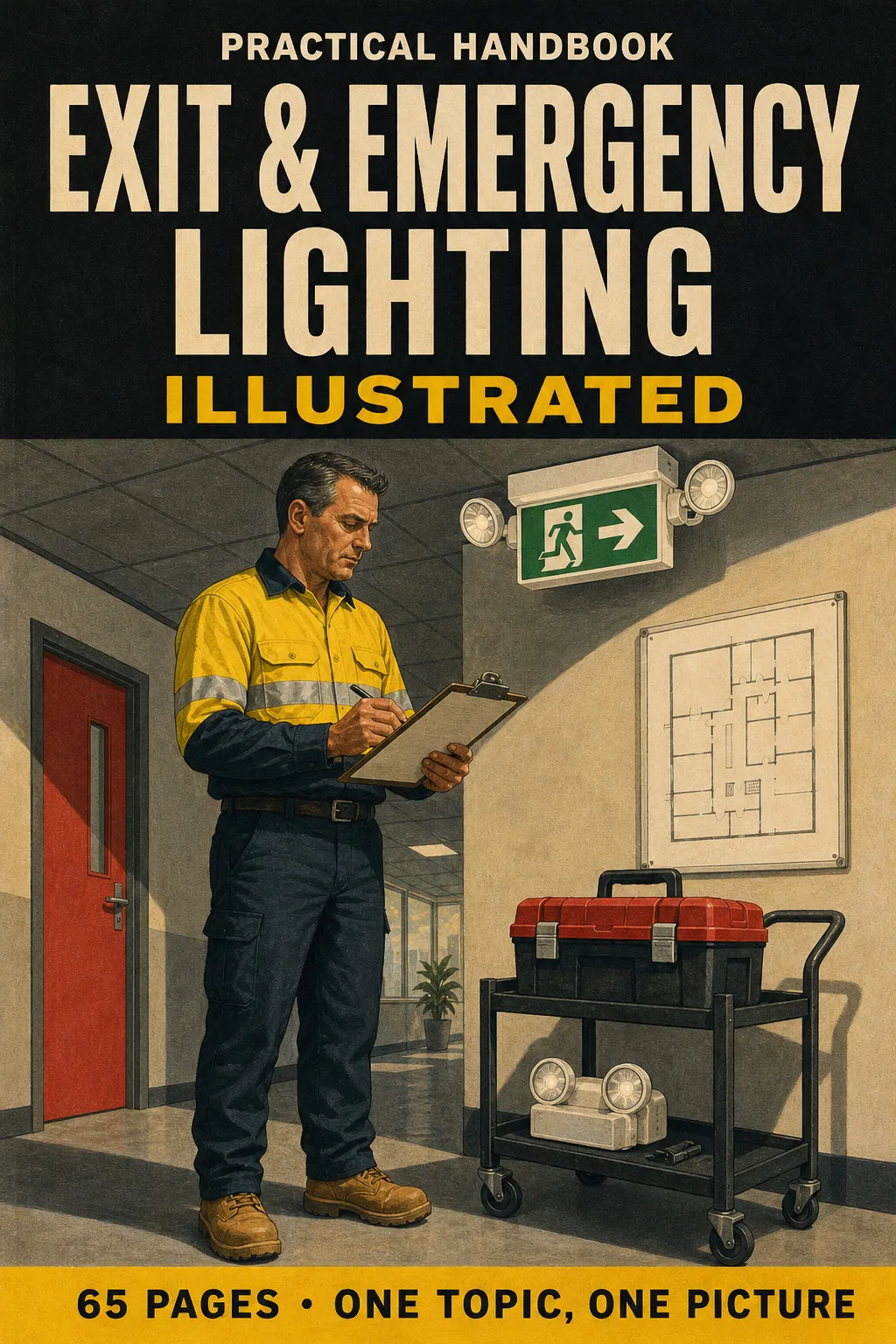
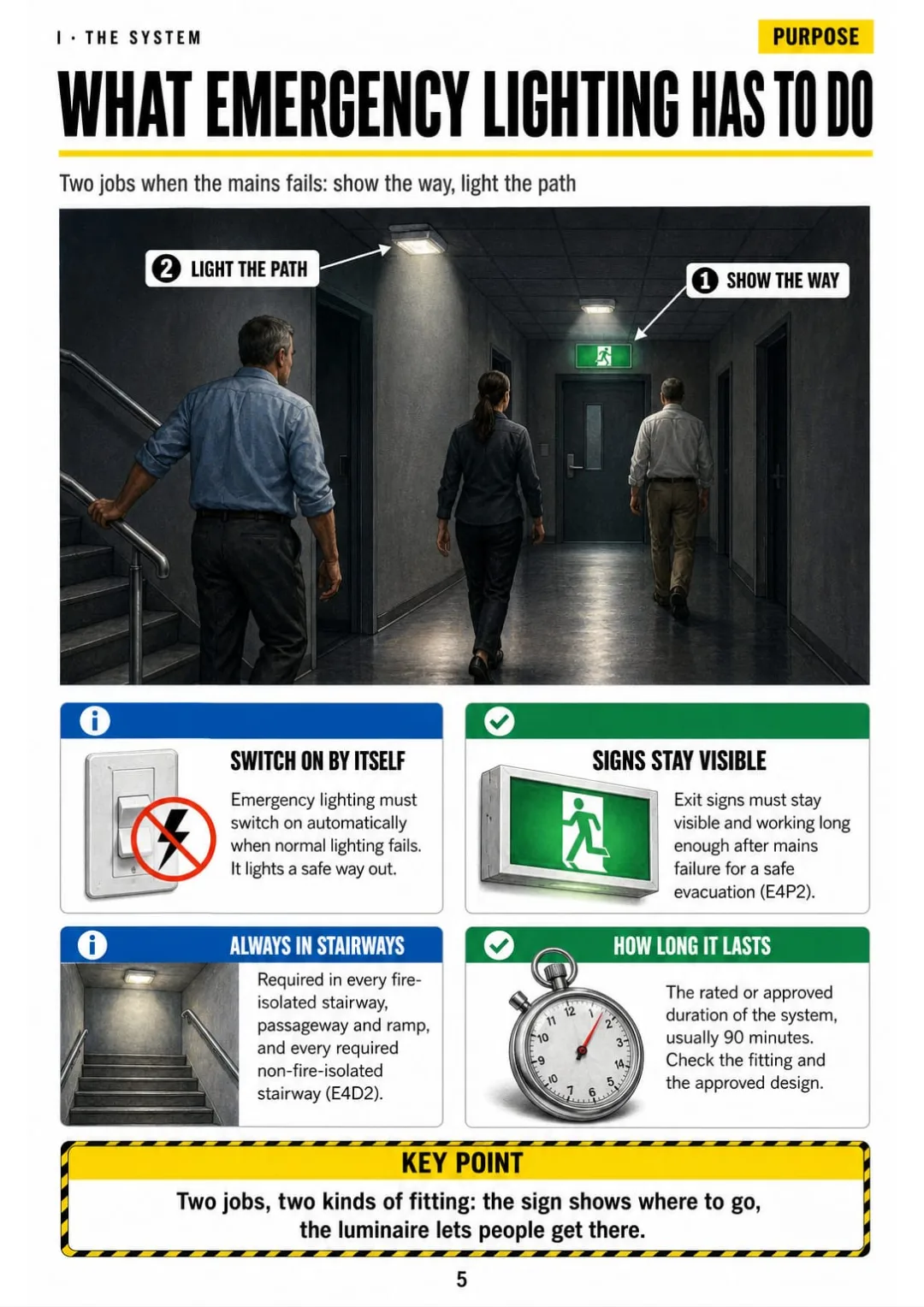
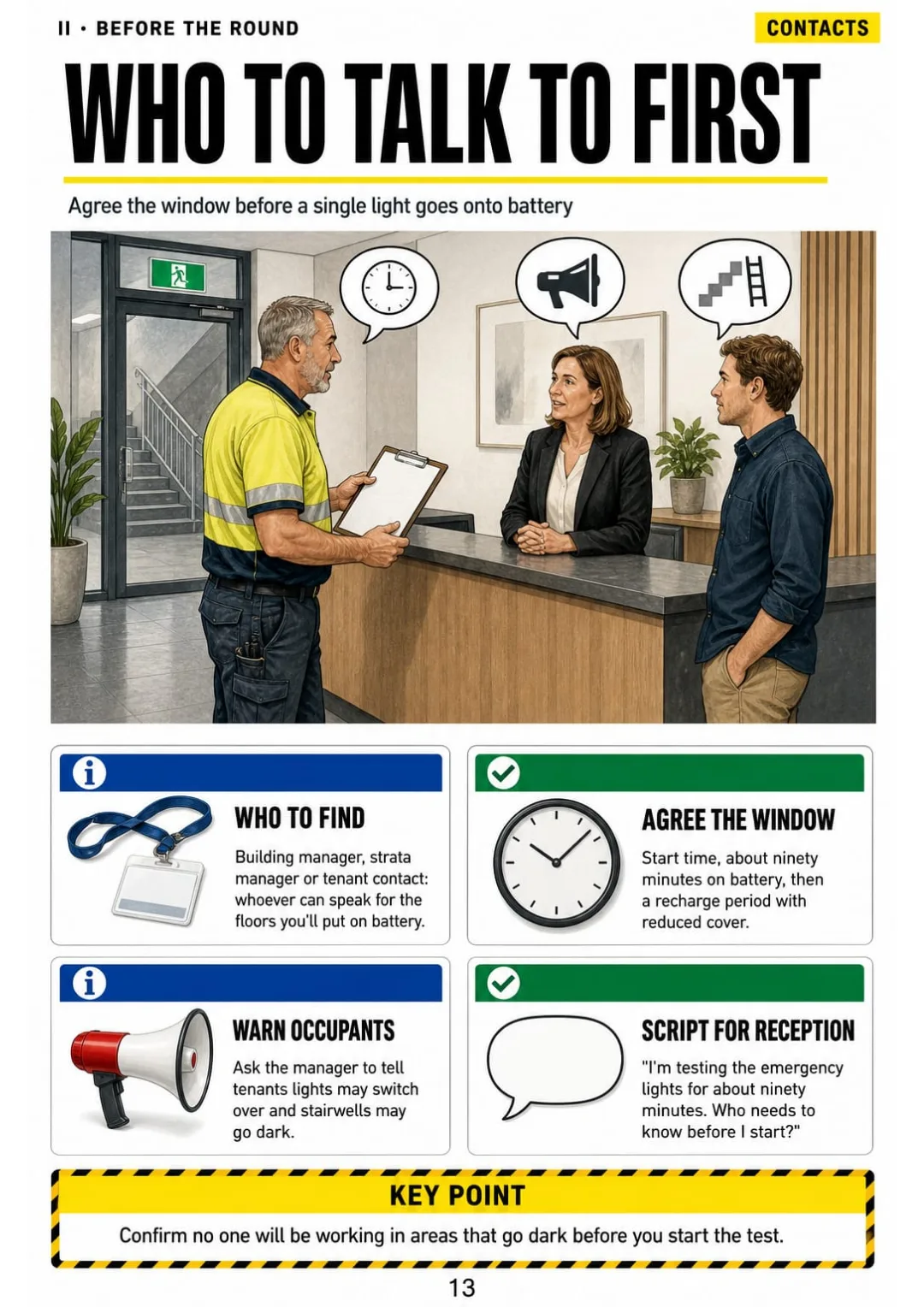
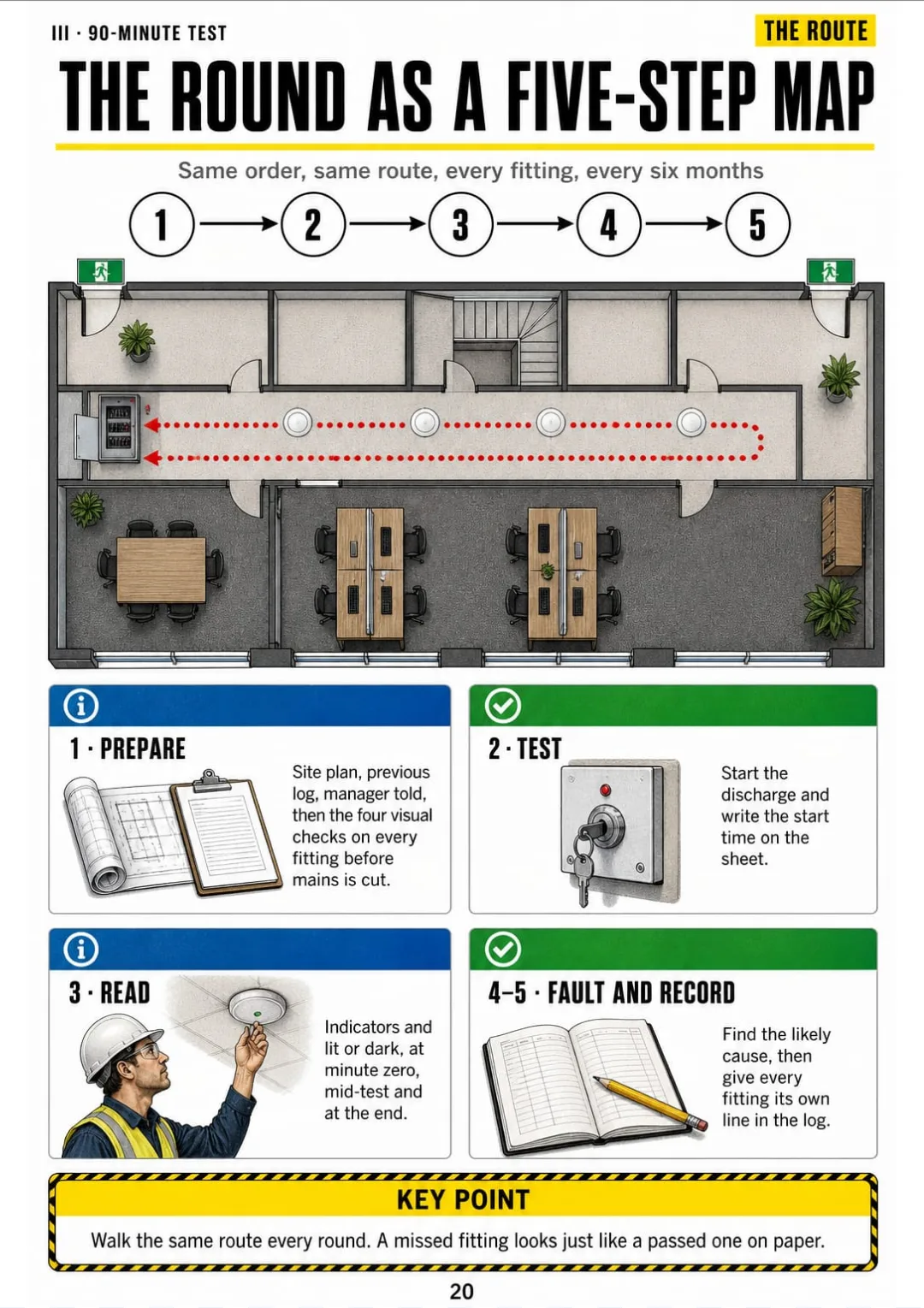
📄 Digital book in PDF · read it on your phone or print it
The 90-minute discharge test, indicator colours, battery, lamp and charger faults, the technician–electrician line, fitting numbers, labels, the logbook and the six-monthly report. Every topic has its own page: the drawing first, then what you need to remember. 65 illustrated pages.
🔒 Secure checkout · PDF by email · 30-day guarantee
Every page has one big drawing and a box with the steps, times and log entries you need to know:


Swipe to see more →
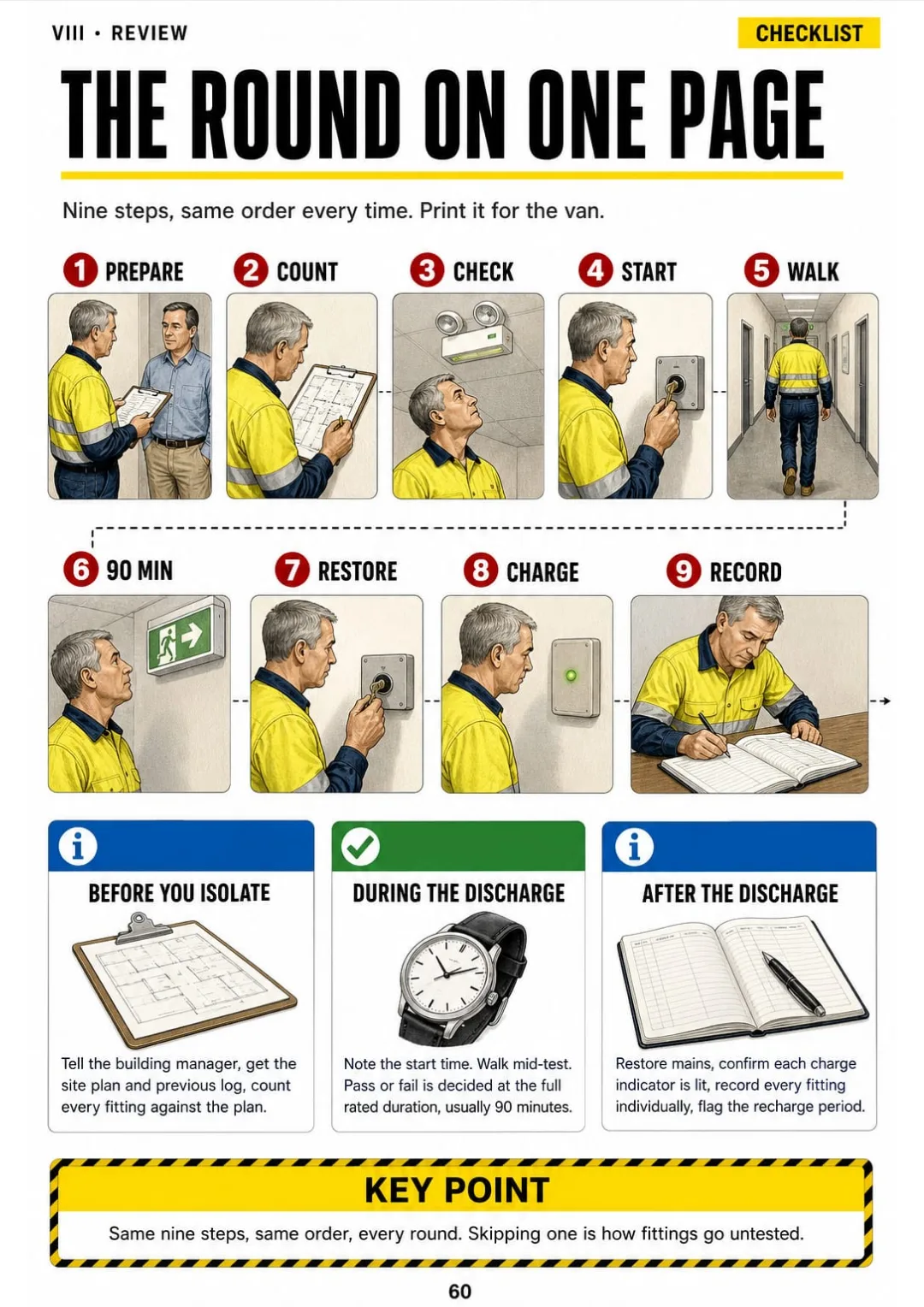
These are real pages from the book. The table of contents is the full one: 8 parts and 61 topics.
You're standing in the foyer of a four-storey strata block, site plan in one hand and last round's log in the other, and you're not sure whether to count the fittings first or start the discharge.
The standard and the course notes cover the round over pages of clauses. Every step is in there, just not in the order you walk the building. So each tech ends up running it their own way.

In this book the round is a single page: prepare → test → read → find the fault → record, drawn as one route across a floor plan, with each step marked where it happens.
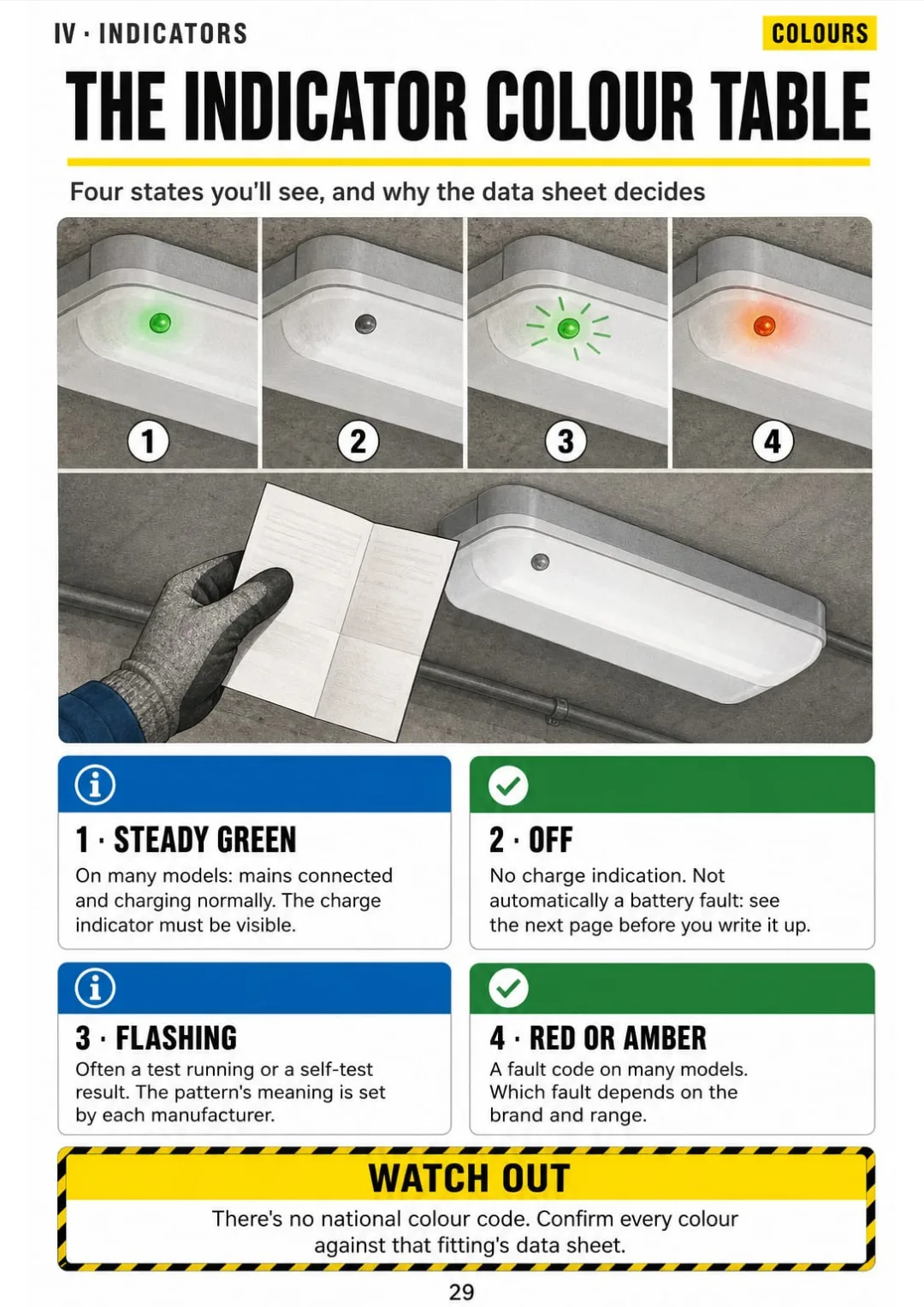
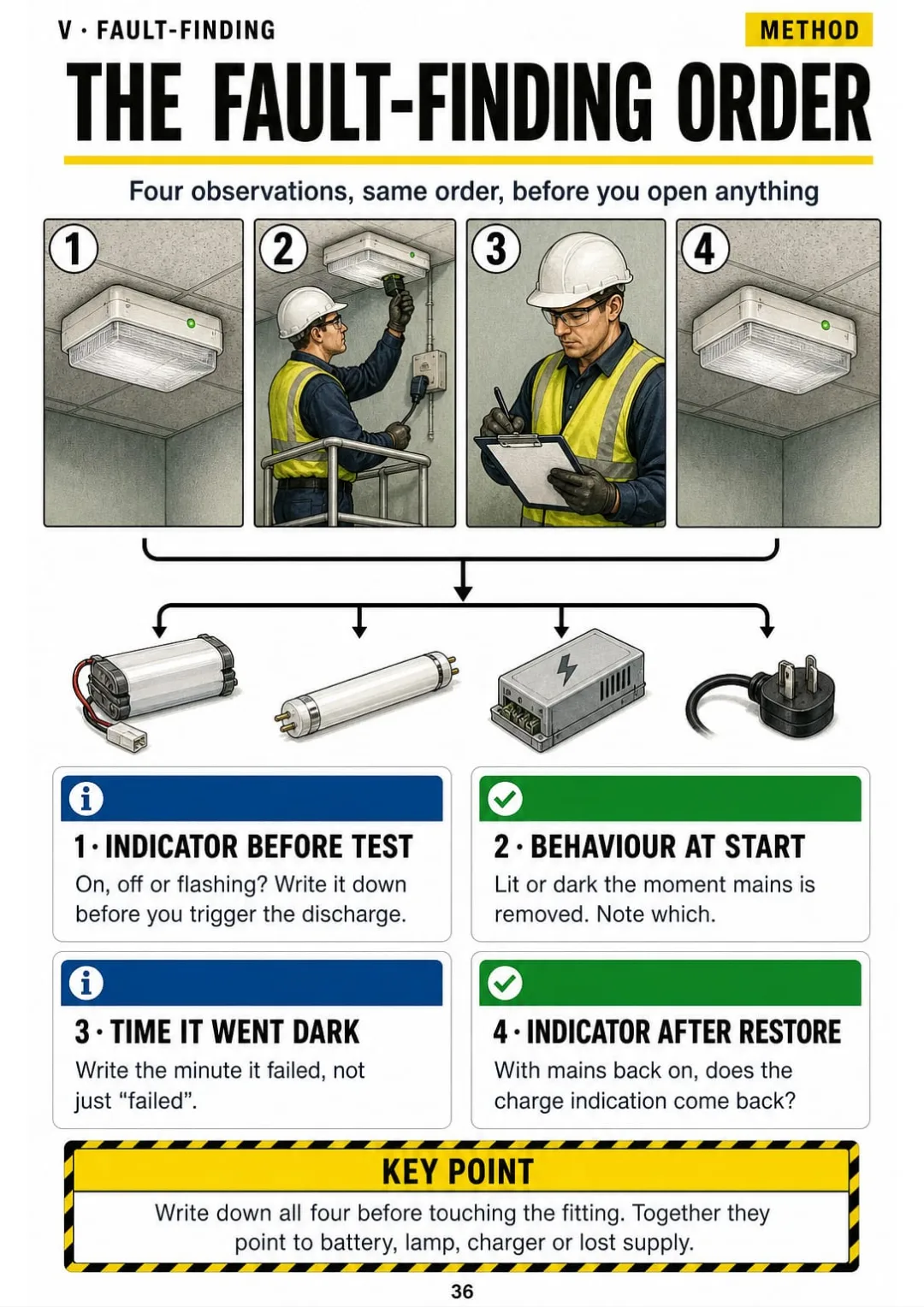
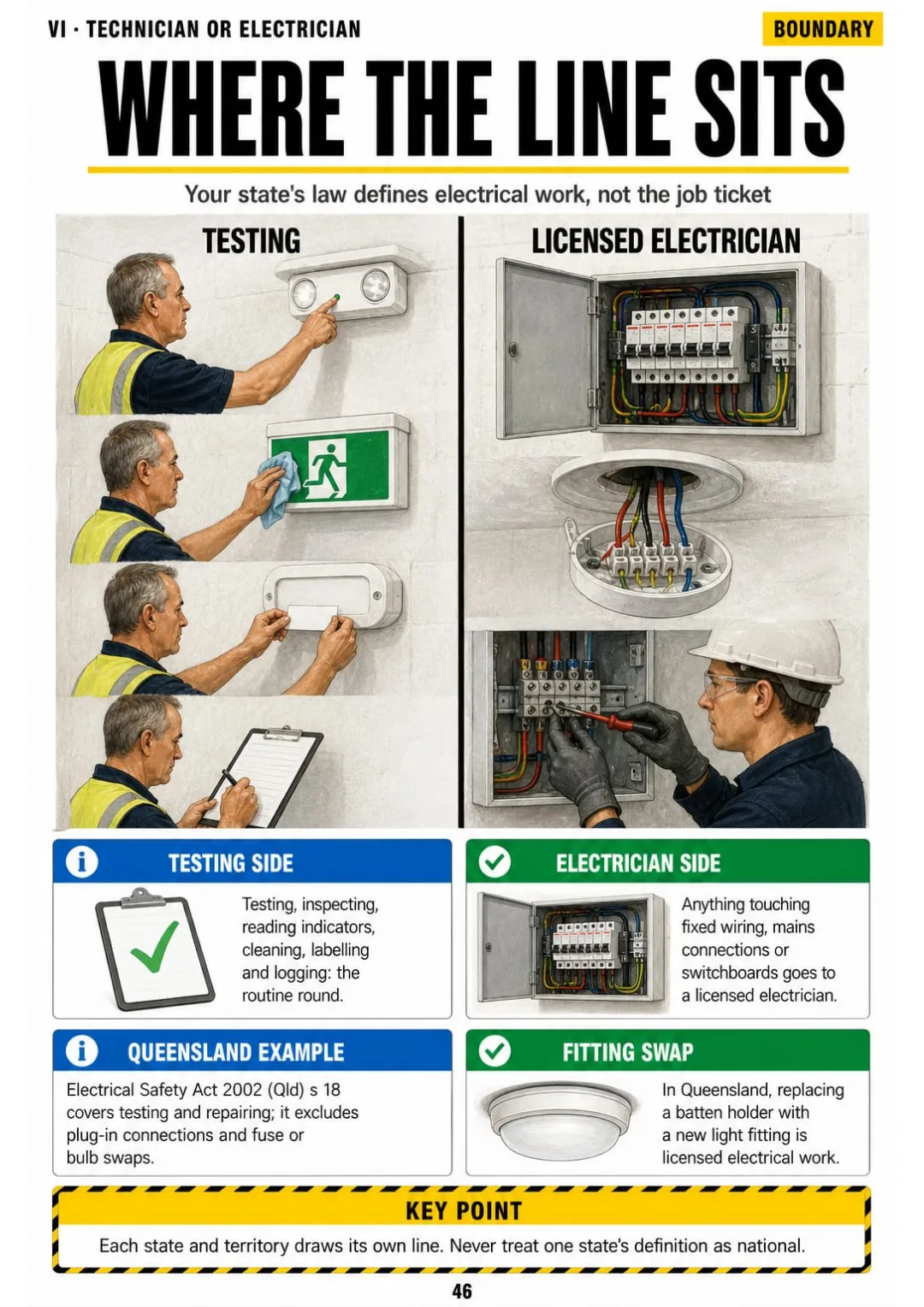
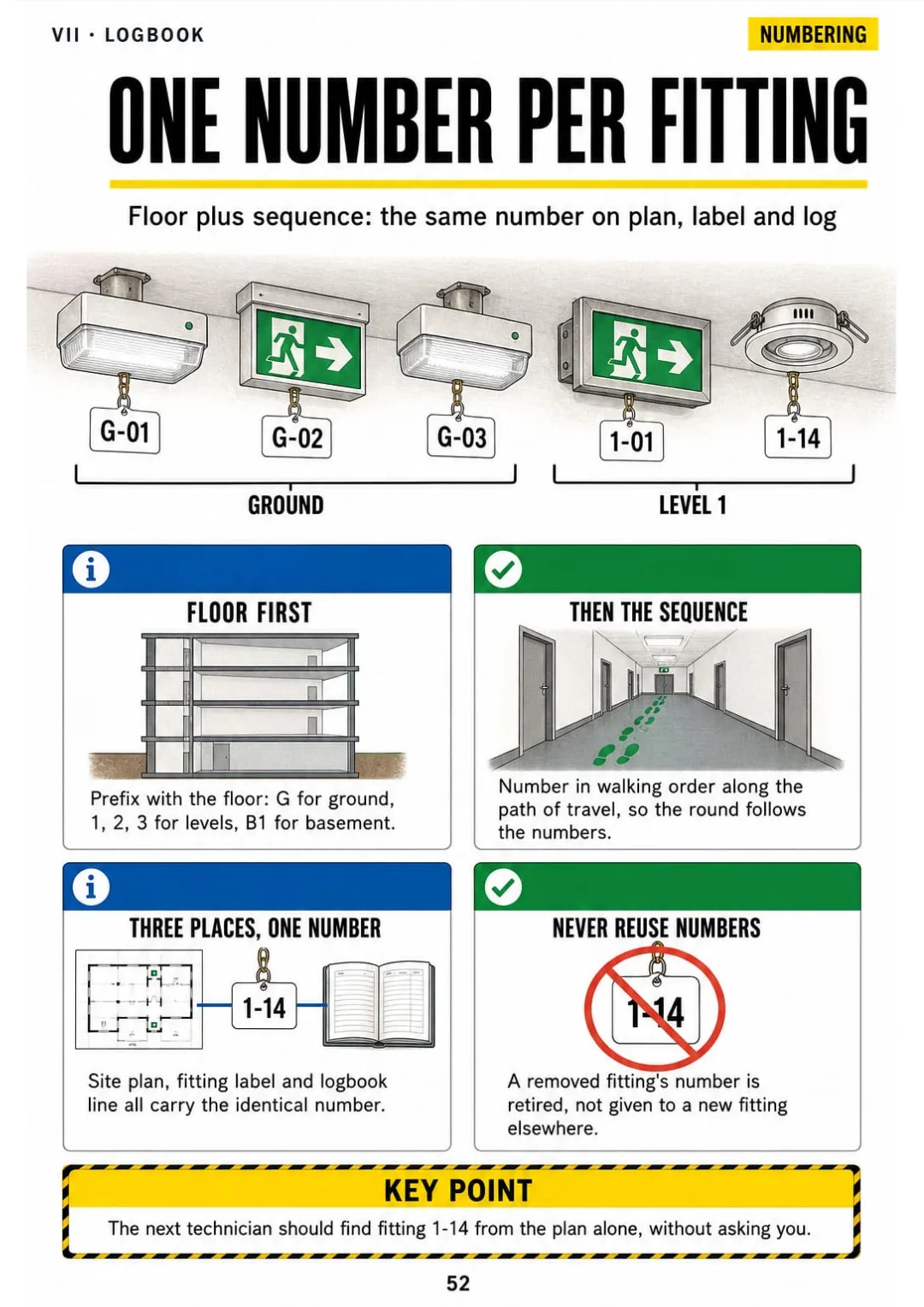
The other topics get the same treatment: the 90-minute timeline, the indicator colour table, the fault-finding order, where the licensed-electrician line sits and the logbook page line by line. Each one on its own page.
You walk the site in the same five steps every time, and the log is finished before you're back in the van, without opening the manual again.

The system at a glance, before the round, the six-monthly 90-minute test, reading the indicators, fault-finding, technician or licensed electrician, labels, logbook and reports, and a final review: 65 pages, all illustrated.
Think of it this way:
It's minute forty of the ninety-minute test on level two and three fittings in the corridor have gone dark. You need to know where to look first, and the building manager is walking towards you.
You open the page on the fault-finding order and see four boxes in a row: indicator, start, failure time, indicator after restore. You check them in that order and write down what you found.

The same goes for the indicator colour table, the 90-minute timeline, charger faults as a decision tree, the technician–electrician line and the logbook page: each one on its own page.
Exit & Emergency Lighting Illustrated is 8 parts and 61 topics, all drawn, finishing with the whole round on one page and the most frequent mistakes.
What you see drawn, you don't have to memorize.
What emergency lighting has to do, exit signs vs luminaires, maintained and non-maintained, single-point vs central battery, self-test systems, inside a fitting, battery types and the standards on one page.
Who to brief, when to run the discharge, the site plan and previous log, your kit, how the test is triggered, counting before you isolate and safety before you climb.
The round as a five-step map, the pre-test check, starting the discharge, the 90-minute timeline, the mid-test walk, the final check, restoring mains, recharge and yearly tasks.
The indicator colour table, an indicator that's off, flashing codes, a green light that still failed, exit sign legibility, monitoring panels and photos as proof.
The fault-finding order, dark at minute zero, dark before 90 minutes, short duration across an area, battery, lamp and LED faults, the charger decision tree, end of life and central systems. A dark fitting becomes a clear defect line, not a guess.
Where the line sits, your state regulator, plug-in batteries and lamps, why isolation isn't a shortcut, writing a defect for the electrician and the boundary flags in this book.
Numbering every fitting, marking up the site plan, the fitting label, the logbook page line by line, pass, fail and not tested, the defect list and the six-monthly report.
The round on one page, the most frequent mistakes (trusting the green light, stopping early, skipping the recharge warning, outdated plans) and the questions a building manager asks.
At the end of the book: The whole round on one page, the most frequent mistakes and the questions a building manager asks.
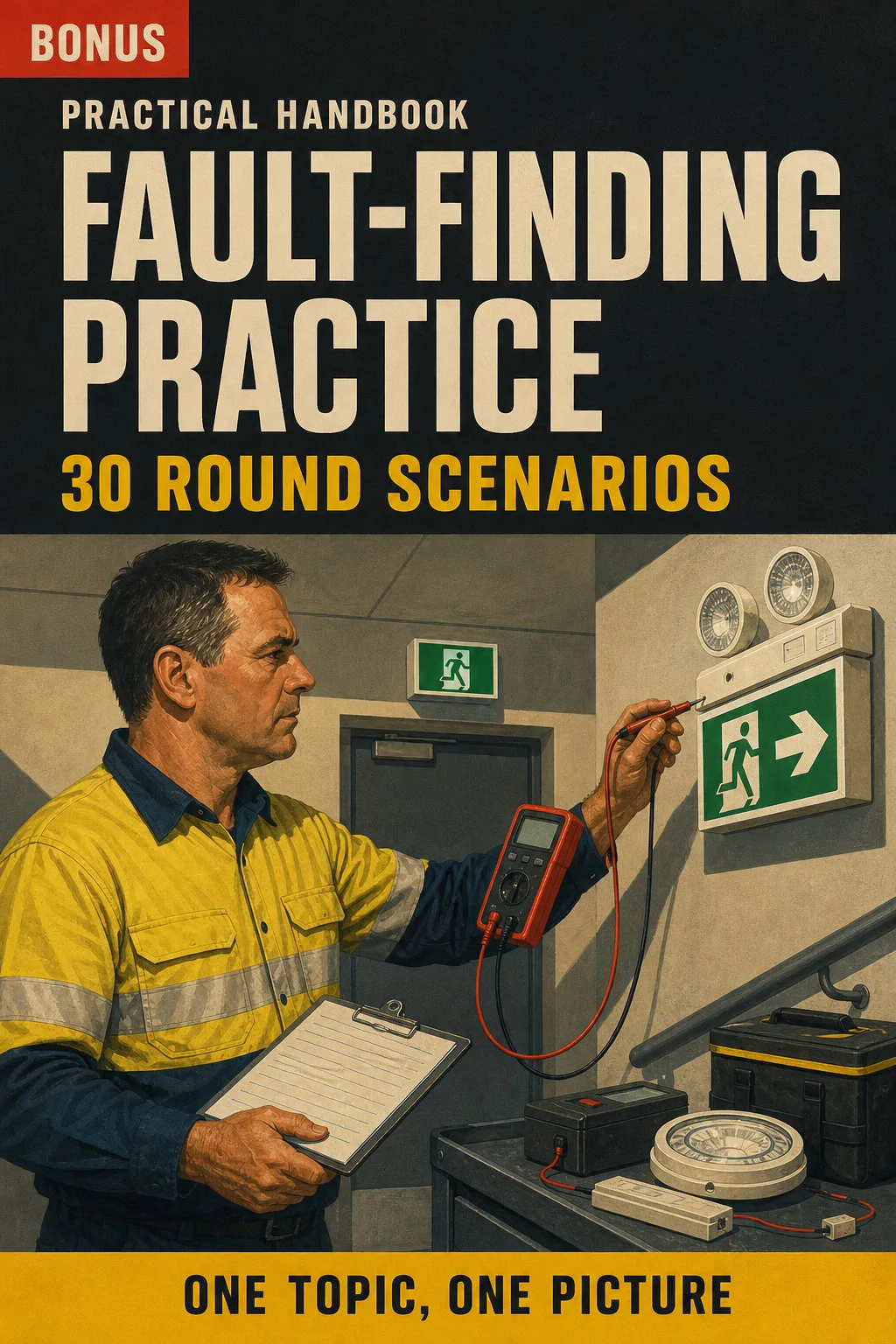
Work through dark fittings, red indicators and short discharge times, decide your next step, then check the answer before you're on site.

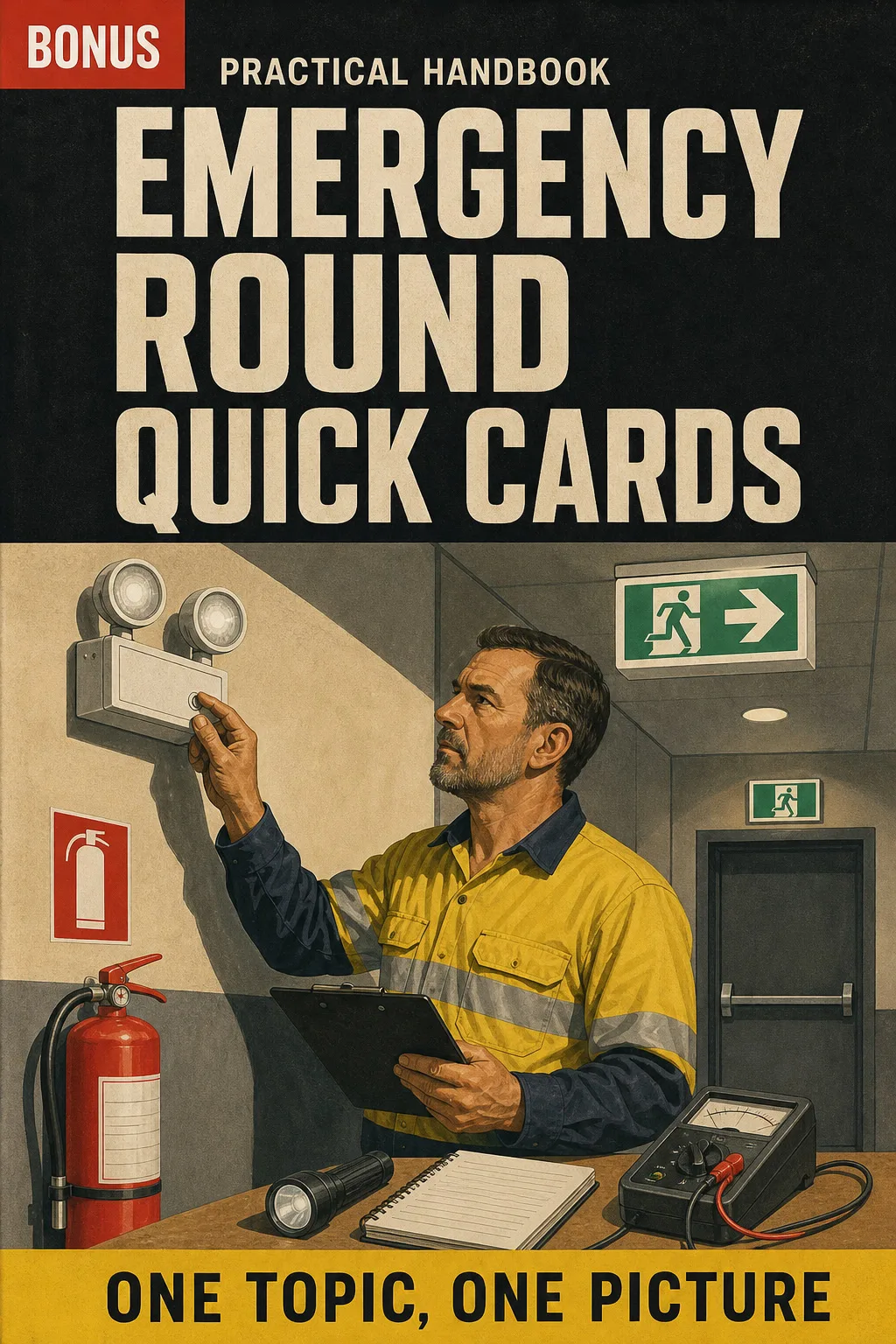
Printable cards with the test steps, indicator colours, common mistakes and log entries, to keep in the van and check at a glance.
📄 This is a digital PDF book sent to your email: nothing is printed or shipped.
PDF by email: We email you Exit & Emergency Lighting Illustrated as a PDF, together with the two free books. It's a single payment: no installments, no extra charges.
You get the whole job laid out page by page, including which parts are licensed electrician work, before you quote your first site.
You walk in with the five-step map, the 90-minute timeline and the logbook page already clear, so nothing on the day catches you out.
You line up your fault-finding, labels and reports with one order, and keep the quick pages in the van to check at a glance.
📄 This is a digital PDF book sent to your email: nothing is printed or shipped.
Try Exit & Emergency Lighting Illustrated for 30 days, bonus books included.
We refund everything if the file won't open, if the book isn't what you see here, if you were charged twice or if the email doesn't arrive. Just email us.
You pay once. No subscriptions.
Yes. It's written for people already working in buildings who want the six-monthly round in one clear order. It doesn't start from zero, but each page is clear enough if emergency lighting is new to your rounds.
It's checked against the current AS/NZS 2293 series, AS 1851, NCC Volume One Part E4 and AS/NZS 3000 for the licensed-work boundary, read alongside Safe Work Australia and state regulator guidance. No text or tables from the standards are reproduced.
No. It's an independent illustrated guide. It isn't published, approved or endorsed by Standards Australia, the ABCB or any regulator.
No. It doesn't replace your training, an electrical licence, the standards or the manufacturer's instructions, and it doesn't give you a certificate or qualification. Work on fixed wiring and replacing hard-wired fittings is for licensed electricians only. What else a non-electrician may do varies by state, so the book points you to your state regulator and flags the boundary on every page where it applies.
No. The 30 fault-finding scenarios are written for this book to practise your next step on site. They aren't questions from any exam or assessment.
The book and the 2 bonus books arrive as PDFs by email.
No. It's a one-off payment, with no subscription.
Yes. The PDF is ready to print, so you can keep the pages and the quick cards in the van.
You have 30 days. We refund everything if the file won't open, if the book isn't what you see on this page, if you were charged twice or if the email doesn't arrive: just email us.
No more rereading clauses that don't stick.
The 90-minute test, drawn so it sticks.
You get to every site knowing where each thing is.
Drawings make studying faster.
The book is right below.
One-time payment: US$ 27 · Guarantee: 30 days · PDF by email
YES, I WANT EXIT & EMERGENCY LIGHTING ILLUSTRATED FOR US$ 27📄 This is a digital PDF book sent to your email: nothing is printed or shipped.